- jnjmetals@outlook.com
- +91 63543 37767
- We keep the electrons moving
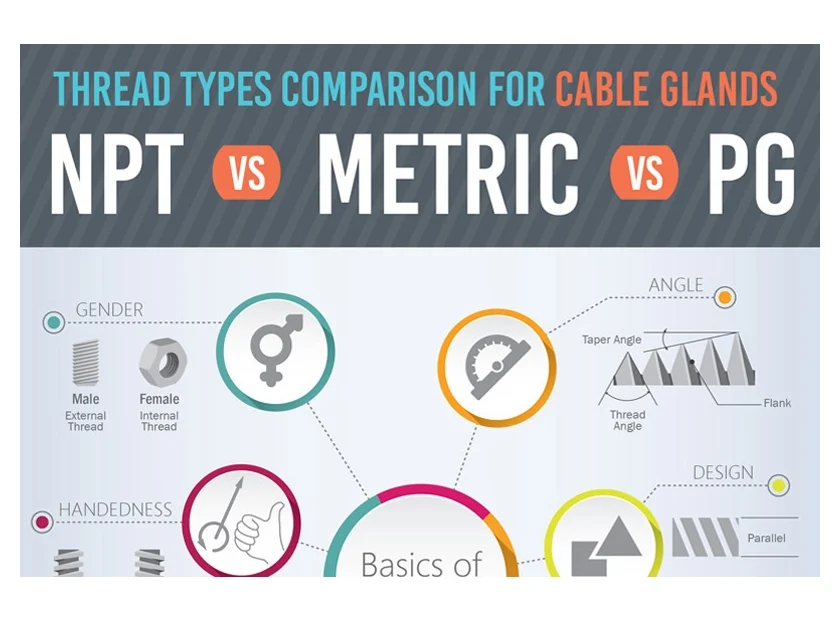
In industrial electrical installations, small design details often decide long-term reliability. One of those details is the thread type used in cable glands. Engineers may not always discuss it at length during planning, but when mismatched threads show up on site, installation delays and compatibility issues quickly follow.
For site engineers and procurement teams working across global projects, understanding cable gland thread standards is not optional anymore. Equipment comes from different regions, standards vary, and systems are expected to work seamlessly together.
This is where Metric, PG, and NPT cable gland thread types become important. Each system has its own logic, design background, and application environment. Choosing the wrong one can create sealing issues, mechanical instability, or even complete installation failure.
This guide breaks down everything in a practical, field-focused way so selection becomes easier during real project execution.
In electrical systems, the thread is not just a mechanical connection. It is the interface between the cable gland and the equipment enclosure. A weak or incompatible interface creates risk, especially in industrial environments where vibration, moisture, and pressure are common.
Different countries historically developed their own thread standards:
Today, global supply chains mix all three. A control panel manufactured in Europe may use metric threads, while instrumentation from the US may require NPT fittings.
For industrial cable glands, this creates a real challenge: compatibility must be verified before installation, not during it. Incorrect thread selection can lead to:
This is why procurement officers now treat thread type as a critical specification, not a minor detail.
Cable gland threads are broadly categorized into three systems:
Each system has a different geometry and sealing philosophy. Understanding these differences helps engineers avoid mistakes during installation.
Metric threads are the most widely used international standard today. Defined under ISO standards, they are identified by the letter “M” followed by a diameter (for example M20, M25).
This system is common in modern electrical cable glands used across Asia, Europe, and many global OEM systems.
Metric threads are straight threads. This means:
This design makes them easy to manufacture at scale.
Metric systems are widely preferred in modern industries because:
In most new industrial projects, brass cable glands with metric threads are the default choice.
Metric threads are commonly used in:
They are considered the “default” in most global manufacturing setups today.
Despite their popularity, metric threads have one limitation:
This means installation quality becomes important for achieving proper IP protection.
PG stands for Panzergewinde, a German-origin thread system historically used in electrical installations.
Although still found in older equipment, PG threads are gradually being replaced by metric systems in modern industries.
PG threads have:
Unlike metric threads, PG sizes do not directly correspond to millimeters, which often creates confusion during replacement.
PG threads are still useful in:
They offer reliable sealing in traditional setups.
PG threaded cable glands are mainly found in:
The biggest challenge with PG systems is declining compatibility:
Most modern cable gland manufacturers now focus on metric and NPT instead.
NPT Threads are a US standard used a lot, in pipes and electrical systems.
They are made for applications where a tight seal is needed under pressure.
NPT Threads help make sure pipes & fittings connect properly and do not leak.
NPT threads are:
Unlike metric threads, the sealing happens within the thread itself.
NPT systems are highly effective because:
They are common in oil, gas, & hydraulic systems.
NPT cable glands are used in:
However, NPT threads require careful handling:
Improper installation can lead to leakage even if the component is high quality.
| Feature | Metric (M) | PG Threads | NPT Threads |
|---|---|---|---|
| Origin | International (ISO) | Germany | USA |
| Thread Type | Straight | Slight taper | Strong taper |
| Sealing Method | Washer/O-ring | Compression | Thread interference |
| Modern Usage | Very high | Declining | High in US industries |
| Compatibility | Excellent | Limited | Regional |
| Installation Ease | Easy | Moderate | Requires precision |
| Industrial Preference | Standard choice | Legacy systems | High-pressure systems |
For site engineers and procurement teams, selection should always be based on system origin and application requirement.
A simple mismatch in thread type can stop installation completely during commissioning.
Even experienced teams make errors when handling mixed equipment environments.
Some common mistakes include:
These mistakes often lead to leakage, damaged panels, or rework during commissioning.
Across industries, thread systems are used in:
Each environment demands correct matching between thread type and system design.
For field engineers, thread compatibility directly affects installation speed, as mismatched threads often require immediate, costly, and time-consuming workarounds on-site.
For procurement teams, the correct specification of thread types is critical for:
Standardizing thread types across projects reduces downtime and simplifies maintenance, allowing for a more streamlined lifecycle for industrial electrical installations.
Reliable manufacturers play an important role in reducing installation errors. By maintaining strict quality control and adhering to international thread specifications, they provide the foundation for safe industrial connections.
A quality-focused cable gland manufacturer ensures:
This becomes especially important in large-scale industrial projects where thousands of glands are installed, and any variation in quality can lead to systemic failures during operation.
Engineers consistently prefer standardized systems because they offer a reliable framework for design, procurement, and maintenance. Adhering to recognized standards like ISO Metric or NPT minimizes variables that lead to failure.
Standardized systems provide several key benefits:
Standardization is not just convenience—it directly impacts project success, safety, and long-term operational costs.
In industrial environments, reliability depends heavily on manufacturing precision. When projects require components that perform under stress, engineers need a partner who understands the technical demands of the field.
JJ Metals supports engineering teams with:
This makes JJ Metals a preferred partner in projects where installation accuracy and long-term performance are paramount to operational success.
Understanding the nuances of cable gland thread types—Metric, PG, and NPT—is essential for site engineers and procurement teams to prevent the costly delays caused by thread mismatching during industrial project execution.
In summary, each thread system serves a specific purpose:
Selecting the correct thread type is more than a technical specification; it is a commitment to better sealing, smoother installations, and the long-term reliability of critical electrical systems.
In industrial environments where precision is the baseline for safety, partnering with an experienced manufacturer like JJ Metals ensures that every cable gland is purpose-built to meet both your specific technical requirements and the environmental challenges of your project, without compromise.
.png)